.png)


A 200-night rental cap doesn’t just limit bookings, it establishes a ceiling on occupancy, RevPAR, and annual revenue. Salt Lake City’s new short-term rental regulations provide a rare opportunity to quantify exactly what that ceiling looks like. Beginning July 1, every licensed short-term rental in Salt Lake City is subject to a new operating framework that includes a 200-night annual rental limit, a two-night minimum stay requirement, individual business licensing, and restrictions on the concentration of short-term rentals within larger residential buildings.
Much of the discussion surrounding the ordinance has focused on housing policy. But for property managers and homeowners, the more immediate question is operational: What happens to revenue when a property can no longer sell every night that demand exists?
Using listing-level market data from the Greater Salt Lake City area, KeyData modeled how a 200-night annual rental cap would have affected year-round vacation rentals based on their 2025 performance. Rather than evaluating the policy itself, the analysis examines how an annual booking limit changes the economics of operating a short-term rental.
The Cap Changes What Operators Optimize
Revenue managers typically have two ways to grow revenue: increase occupancy or increase rate. A 200-night cap removes one of those levers. Once a property reaches its annual limit, additional demand no longer translates into additional occupied nights. Instead, every remaining booking becomes more valuable because there are fewer opportunities to generate revenue throughout the year.
From a performance perspective, the math is straightforward. A property limited to 200 rental nights can achieve a maximum annual paid occupancy of 54.8% (200 / 365).
That occupancy ceiling also creates a ceiling on RevPAR. Even if traveler demand continues to grow, annual RevPAR can only increase through higher ADR once the maximum number of rental nights has been reached. The regulation doesn’t change demand, it changes how operators capture value from that demand.
Nearly Half of Year-Round Listings Would Have Reached the Limit
Not every listing operates throughout the year. Some are seasonal properties, while others enter or leave the market during the year. To better understand the effect on active vacation rentals, the analysis focused on entire-home listings that were available for at least 330 days during 2025.
That cohort included 3,144 year-round listings.
Of those:
- 1,563 listings (49.7%) booked more than 200 nights
- 1,581 listings (50.3%) remained below the threshold
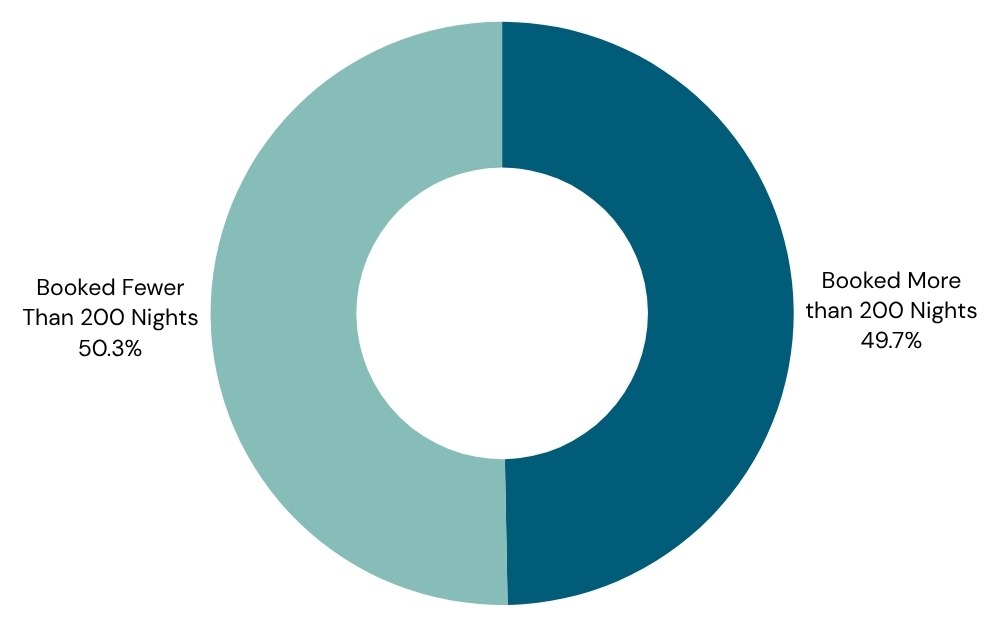
Nearly half of the listings in the analysis crossed the 200-night threshold during 2025. These are active, year-round rentals that consistently generate demand across the calendar. Under the new ordinance, they would have reached the annual limit before year-end despite continued booking demand.
The Revenue Impact Is Meaningful
Occupancy is only the first effect. For listings exceeding 200 booked nights, KeyData modeled the revenue associated with nights above the allowable limit using each property’s realized ADR.
Among affected listings:
- Median nights above the cap: 43
- Median modeled revenue associated with those nights: approximately $7,300
- Average modeled revenue associated with those nights: approximately $9,100
- Median reduction in annual revenue potential: 18%
These figures should not be interpreted as forecast revenue losses. In practice, operators would almost certainly adapt their pricing strategy by prioritizing higher-value nights, increasing ADR during peak demand periods, or adjusting minimum stay requirements. The analysis instead illustrates the amount of revenue currently generated beyond the 200-night threshold under existing market conditions.
The Bigger Story Is RevPAR
RevPAR reflects the combined effect of occupancy and ADR, making it one of the industry’s most useful measures of revenue performance. Because a 200-night cap limits occupancy, it also limits the maximum RevPAR a property can achieve.
For listings exceeding the threshold, the modeled cap reduced median calendar RevPAR by approximately 20%, assuming ADR remained unchanged. Maintaining the same annual revenue under the cap would require the median affected listing to increase ADR by approximately 23.5%.
That’s a significant shift in strategy. Rather than relying on additional bookings to grow revenue, operators must generate more value from every booking they are permitted to accept.
Smaller Homes Are More Likely to Reach the Cap
One of the more surprising findings is that the properties most affected by the regulation aren’t necessarily the largest homes. Smaller listings were substantially more likely to exceed 200 booked nights.
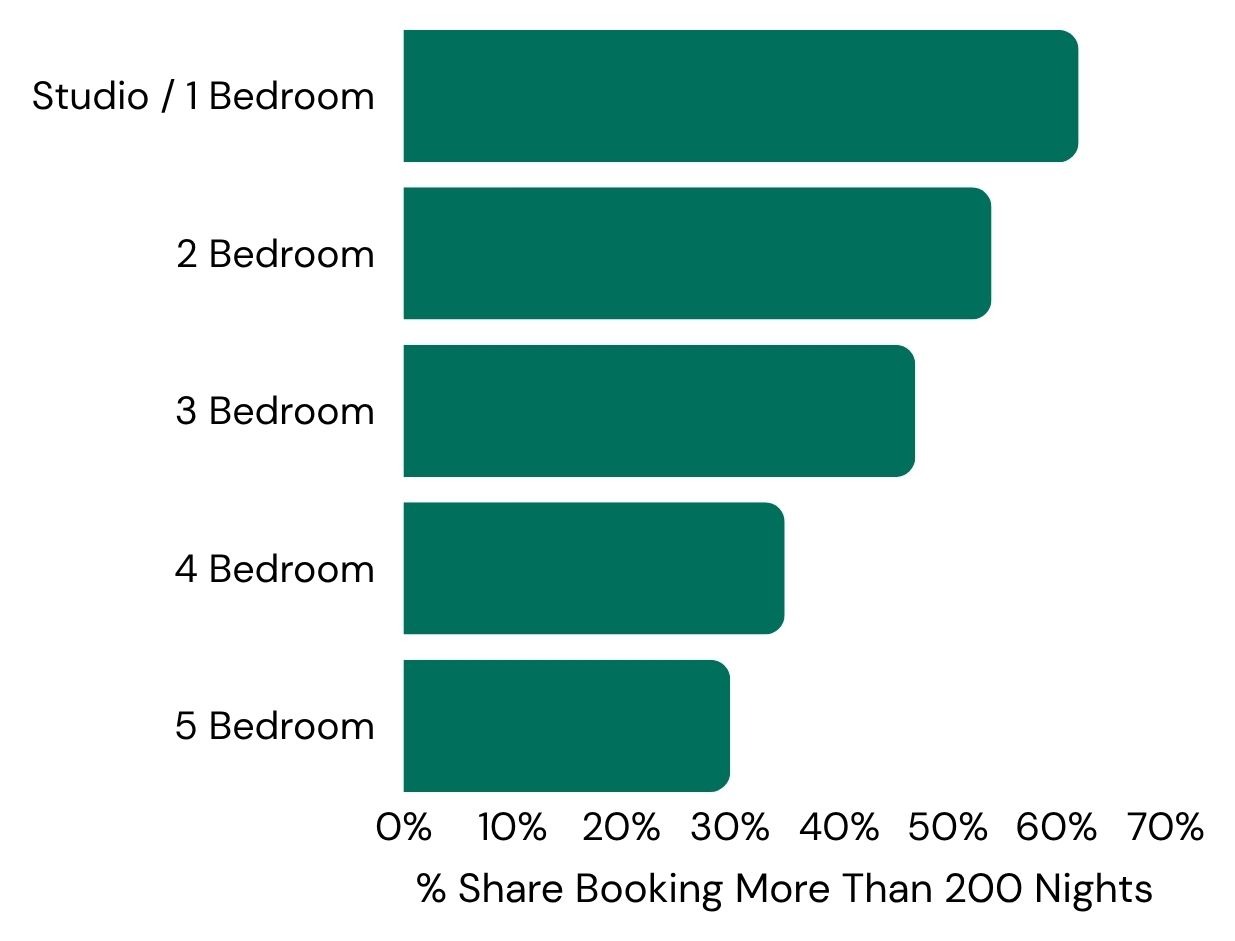
The explanation lies in demand patterns rather than pricing. Smaller homes typically attract a broader mix of travelers throughout the year, including business travel, university visitors, temporary relocations, and shorter leisure trips. Larger homes often command higher ADRs but rely more heavily on seasonal demand, leaving more unoccupied nights outside peak travel periods.
As a result, the properties most likely to reach the annual cap aren’t necessarily the highest-priced, they’re often the most consistently occupied.
Operating Under a Fixed Revenue Ceiling
A rental cap doesn’t eliminate the need for revenue management, it makes it more important. When occupancy is constrained, pricing becomes the primary driver of revenue growth. Every permitted rental night carries greater value, increasing the importance of understanding exactly when demand is strongest and where pricing opportunities exist.
For operators working within annual rental limits, that means:
- Prioritizing high-value weekends, holidays, and major events
- Holding rate during periods of strong demand rather than discounting for occupancy
- Evaluating owner blocks more strategically
- Using booking pace and market benchmarks to identify the most valuable nights to sell
- Maximizing revenue per available booking night rather than simply maximizing occupancy
The objective shifts from filling the calendar to optimizing the calendar.
Market Data Helps Quantify Policy Decisions
Salt Lake City is one of several destinations introducing tighter oversight of short-term rentals, and similar discussions are taking place across North America.
Whether future regulations focus on annual rental nights, licensing, density restrictions, or zoning, one principle remains the same: policy decisions influence market performance in measurable ways.
Traditionally, market data has been used to understand demand, pricing, and competitive positioning. Increasingly, it also provides a way to quantify how regulation changes the revenue potential of an individual property.
For property managers, homeowners, and policymakers, understanding those trade-offs is essential. Regulations may define how a property can operate, but data helps explain what those operational limits mean in practice. KeyData helps property managers and destinations turn market data into actionable insights, with real-time benchmarking, pricing intelligence, and demand trends that support better decisions in changing regulatory environments. Learn more about how KeyData’s market intelligence platform helps vacation rental professionals navigate evolving markets.
Methodology
This analysis uses listing-level scraped market data from calendar year 2025 for the Greater Salt Lake City market. To focus on established vacation rentals, the primary analysis includes entire-home listings that were active on booking platforms for at least 330 days during the year and recorded at least one booked night. Revenue associated with nights above the cap was modeled using each listing’s realized 2025 ADR and is intended to illustrate how 2025 performance would have been affected under a 200-night annual rental limit. Because the ordinance applies specifically within Salt Lake City municipal limits, the results should be interpreted as a market-based scenario analysis rather than a direct estimate of the ordinance’s impact on licensed properties within the city.
Frequently Asked Questions
What is Salt Lake City’s 200-night short-term rental cap?
Salt Lake City’s ordinance limits licensed short-term rentals to a maximum of 200 rental nights per calendar year. The regulations also include licensing requirements, a two-night minimum stay, and restrictions on the concentration of short-term rentals in certain residential buildings.
How does a 200-night cap affect vacation rental revenue?
A rental cap limits the maximum number of nights a property can be booked, creating a ceiling on annual occupancy. Once that limit is reached, additional revenue must come from higher nightly rates rather than additional bookings, making pricing strategy more important than occupancy growth.
Which properties are most likely to be affected?
KeyData’s analysis found that smaller, year-round listings were most likely to exceed 200 booked nights. More than 60% of studio and one-bedroom homes surpassed the threshold in 2025, compared with 30% of homes with five or more bedrooms.
What can property managers do to adapt to a 200-night rental limit?
When occupancy is capped, maximizing revenue depends on selling the most valuable nights. Property managers can adapt by optimizing pricing during peak demand periods, setting strategic minimum stays, monitoring booking pace, and using market benchmarks to prioritize higher-value reservations over simply filling the calendar.





