.png)


Salt Lake City recently approved one of the most comprehensive updates to its short-term rental regulations in recent years. Beginning July 1, licensed short-term rentals are subject to a new operating framework that includes:
- A maximum of 200 rental nights per calendar year
- A two-night minimum stay
- Individual business licensing requirements
- New limits on short-term rental concentration within multifamily buildings, allowing only one licensed short-term rental in buildings with 10 or fewer units and limiting buildings with more than 10 units to no more than 10% of units as short-term rentals.
Much of the public discussion has understandably centered on housing. For destination organizations, however, another question deserves attention: How do these regulations change the destination’s ability to accommodate visitors?
To help answer that question, KeyData analyzed listing-level scraped market data from the Greater Salt Lake City market to model how the new 200-night rental cap would have affected year-round vacation rentals based on their 2025 performance. While the ordinance applies specifically within Salt Lake City municipal boundaries, the broader market provides a useful view of how similar inventory performs under current demand patterns.
The analysis is not intended to evaluate whether the policy is right or wrong. Instead, it explores how annual rental limits could influence accommodation capacity, seasonality, and tourism performance.
Not Every Part of the Ordinance Carries the Same Tourism Impact
The ordinance introduces several new operating requirements, but they are unlikely to influence visitor accommodation equally. The two-night minimum stay is expected to have relatively little effect on overall tourism. Across the analyzed listings, the blended average length of stay during 2025 was 4.06 nights, meaning relatively few bookings would have fallen below the new minimum. Some one-night demand may simply shift to hotels, potentially increasing hotel occupancy and lodging tax collections rather than reducing visitation.
The 200-night annual rental cap is fundamentally different. Unlike a minimum stay requirement, it places a fixed ceiling on the number of visitor nights a property can accommodate each year. That makes it the regulation most likely to influence destination accommodation capacity.
Nearly Half of Year-Round Listings Would Have Reached the Cap
To focus on established vacation rentals, the analysis examined entire-home listings that were active for at least 330 days during 2025.
That cohort included 3,144 listings.
Of those:
- 1,563 listings (49.7%) booked more than 200 nights
- 1,581 listings (50.3%) remained below the threshold
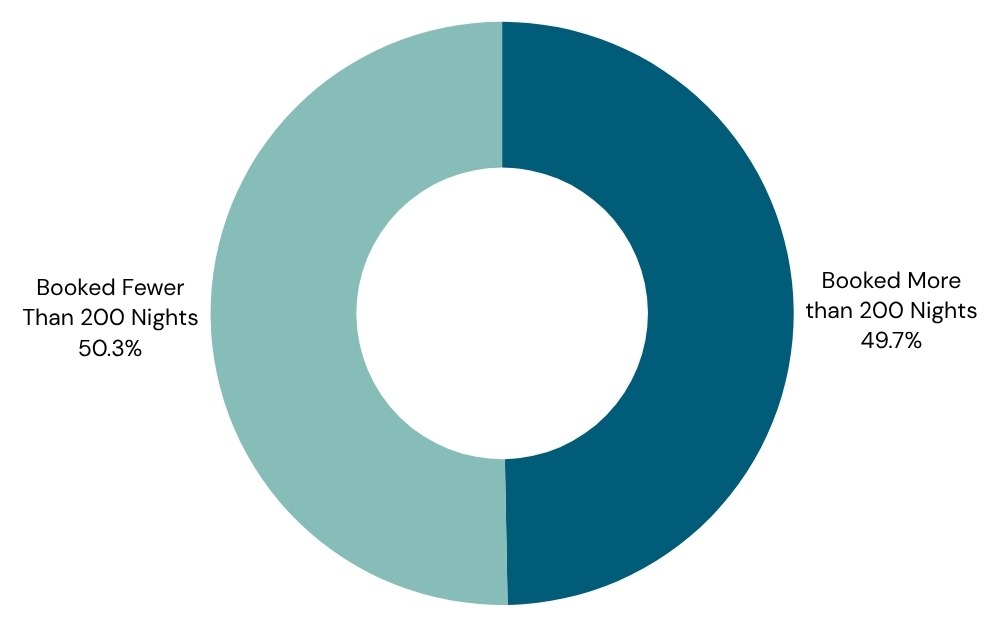
Nearly half of year-round listings would have reached the annual rental limit under their existing booking patterns. Collectively, those listings generated approximately $14.6 million in lodging revenue beyond night 200 during 2025.
Those figures should not be interpreted as forecast revenue losses. Operators would almost certainly adjust pricing strategies, and some traveler demand could shift to hotels or nearby communities. Instead, the analysis quantifies the scale of visitor accommodation currently supported by nights beyond the proposed annual limit.
The Bigger Story May Be Shoulder Season
Perhaps the most interesting implication isn’t visible in the historical data, it’s how operators are likely to respond. When bookings become limited to 200 nights per year, operators are unlikely to accept reservations evenly across the calendar. Instead, they’ll naturally prioritize the highest-value nights like peak ski weeks, major conventions, Holiday weekends, and large sporting events. Those nights become even more valuable because every booking uses one of a limited number of annual rental opportunities.
The nights most likely to disappear are the lower-rate shoulder-season and off-season nights. Ironically, that’s precisely the inventory many destination organizations spend their marketing budgets trying to fill. Rather than reducing peak accommodation capacity, the regulation may constrain availability during need periods, making shoulder-season demand generation more difficult even if traveler interest exists.
Capacity Constraints May Affect Visitor Mix
The analysis also suggests the cap is unlikely to affect every accommodation type equally. Smaller homes are considerably more likely to exceed 200 booked nights than larger luxury properties.
- 62% of studio and one-bedroom listings exceeded 200 nights.
- 30% of homes with five or more bedrooms exceeded the threshold.
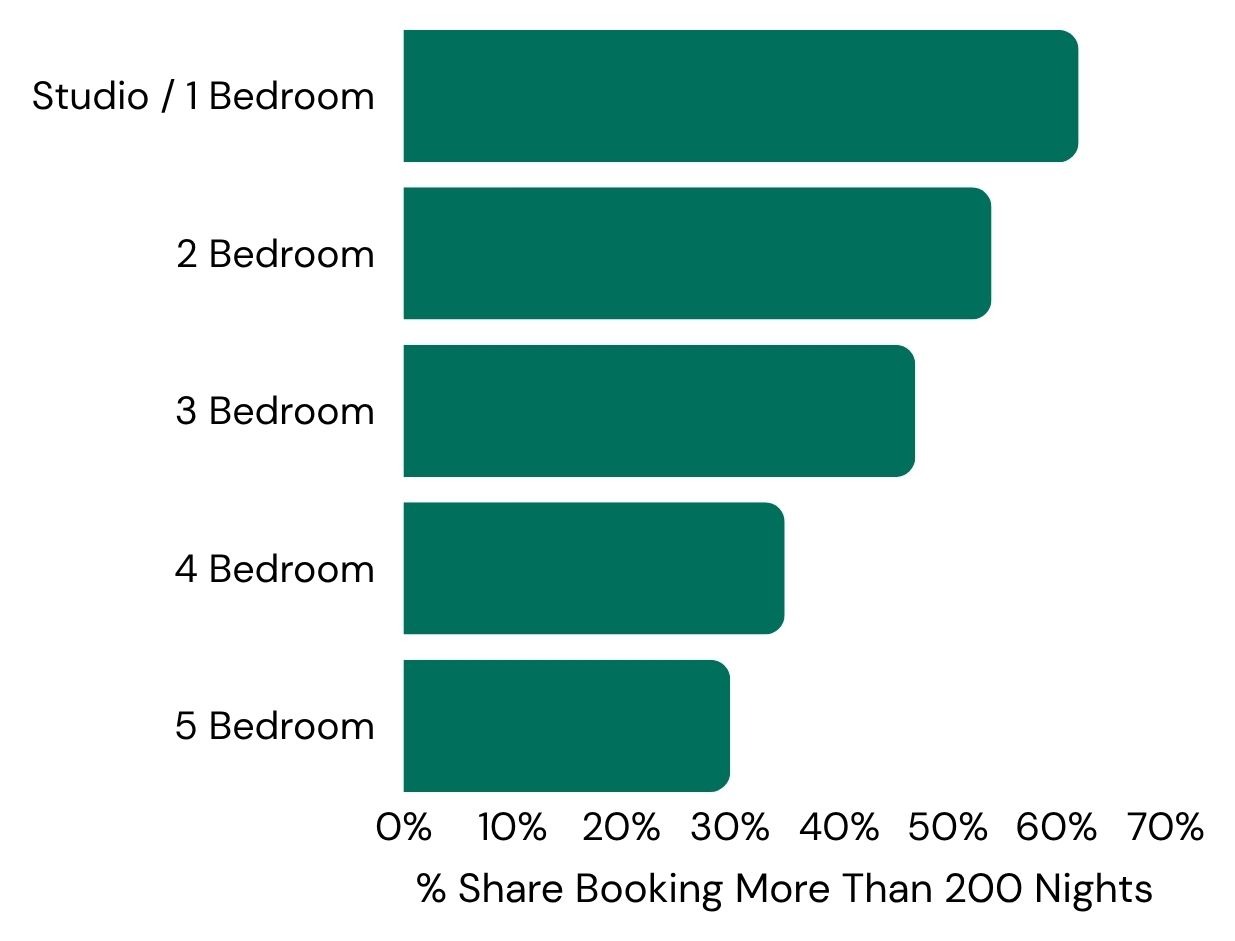
These smaller properties often provide the most affordable accommodation for business travelers, university visitors, couples, temporary relocations, and budget-conscious leisure travelers. If these listings exhaust their annual rental nights first, destinations may lose capacity in their most accessible accommodation segment while larger luxury homes continue operating with relatively little disruption.
That shift could influence visitor mix and create additional challenges for destinations competing to attract conventions, tournaments, and other group business that depends on a broad supply of moderately priced accommodations.
What Destination Organizations Should Measure Next
One of the biggest unknowns is how the regulations will influence tourism over time. The answer won’t be found in annual occupancy.
Instead, destination organizations should monitor:
- Monthly accommodation availability
- Seasonal inventory levels
- Shoulder-season capacity
- Booking pace by arrival month
- Changes in accommodation mix
- Hotel displacement during high-demand periods
Equally important is understanding how the regulations affect tourism tax collections. Fewer short-term rental nights could reduce tax revenue generated by vacation rentals. At the same time, stronger licensing requirements may bring previously unregistered operators into compliance, increasing reported tax collections even if annual rental nights decline.
That question can only be answered through municipal licensing and tax data over multiple years.
Data Helps Destinations Understand Policy Trade-Offs
Housing policy and tourism policy often pursue different objectives. A regulation that successfully returns housing to local residents may also reduce visitor accommodation capacity. Destination organizations don’t need market intelligence to determine whether a policy is “good” or “bad”, they need it to understand what changes, when those changes occur, and how these changes influence visitor demand and tourism performance. As more communities evaluate short-term rental regulations, objective market data will become increasingly valuable for measuring policy outcomes rather than relying on assumptions.
KeyData helps destination organizations monitor accommodation supply, visitor demand, pricing, booking behavior, and tourism performance across hotels and short-term rentals, giving destination leaders the intelligence they need to understand market changes and make data-informed decisions.
Discover the trends shaping your destination with market-specific vacation rental performance insights. Request a demo to see how KeyData can help.
Methodology
This analysis uses listing-level scraped market data from calendar year 2025 for the Greater Salt Lake City market. To focus on established vacation rentals, the primary analysis includes entire-home listings that were active on booking platforms for at least 330 days during the year and recorded at least one booked night. Revenue associated with nights above the 200-night threshold was modeled using each listing’s realized 2025 ADR and is intended to illustrate how 2025 performance would have been affected under an annual rental cap. Because the ordinance applies specifically within Salt Lake City municipal limits, the findings should be interpreted as a market-based scenario analysis rather than a direct estimate of the ordinance’s impact on licensed properties within the city.
Frequently Asked Questions
What changed under Salt Lake City’s new short-term rental ordinance?
Beginning July 1, licensed short-term rentals in Salt Lake City are subject to a 200-night annual rental limit, a two-night minimum stay requirement, individual business licensing, and new restrictions on short-term rental concentration within multifamily buildings. Buildings with 10 or fewer units are limited to one license, while buildings with more than 10 units may dedicate no more than 10% of units to short-term rentals.
Why is the 200-night cap more significant than the two-night minimum stay?
The average stay length across the analyzed listings was 4.06 nights, meaning relatively few reservations fall below the new two-night minimum. The annual rental cap, however, limits the total number of visitor nights a property can accommodate, making it the regulation most likely to influence accommodation capacity and tourism performance.
Does this analysis only include Salt Lake City?
No. The analysis uses listing-level scraped market data from the Greater Salt Lake City market to model how a 200-night annual rental cap would affect established year-round vacation rentals. While the ordinance applies only within Salt Lake City, the broader market provides useful context for understanding potential impacts on accommodation supply.
Could the cap affect shoulder-season tourism?
Potentially. Operators working within a fixed annual rental limit are likely to prioritize higher-value booking periods such as holidays, major events, and peak ski weeks. That may reduce accommodation availability during shoulder seasons, when destination organizations typically focus marketing efforts to stimulate demand.
Will the regulations reduce tourism tax revenue?
It’s too early to know. Fewer short-term rental nights could reduce STR-generated lodging taxes, but stronger licensing requirements may increase compliance and tax collection from previously unregistered operators. Evaluating the net impact will require municipal licensing and tax data over multiple years.





