


Key Takeaways
- Adjusted RevPAR is pacing ahead of last year in 14 of 19 U.S. ski markets, with stronger occupancy driving much of the growth.
- Taos, NM (+88%), Killington, VT (+68%), Heavenly, CA (+49%), and Mammoth Lakes, CA (+48%) are pacing furthest ahead, although several of the largest percentage gains are coming from relatively low occupancy levels.
- The five markets pacing behind are all major Rocky Mountain destinations: Steamboat Springs, CO; Winter Park, CO; Park City, UT; Summit and Eagle Ski Areas, CO; and Jackson Hole, WY.
- Pricing and occupancy are not always moving together. In several markets, stronger occupancy is more than offsetting lower ADR, while higher rates are helping offset softer occupancy elsewhere.
- Weather remains an important variable following a difficult 2025–26 snow season across parts of the West, while El Niño could bring a different pattern this winter.
Most Ski Markets Are Entering Winter Ahead of Last Year
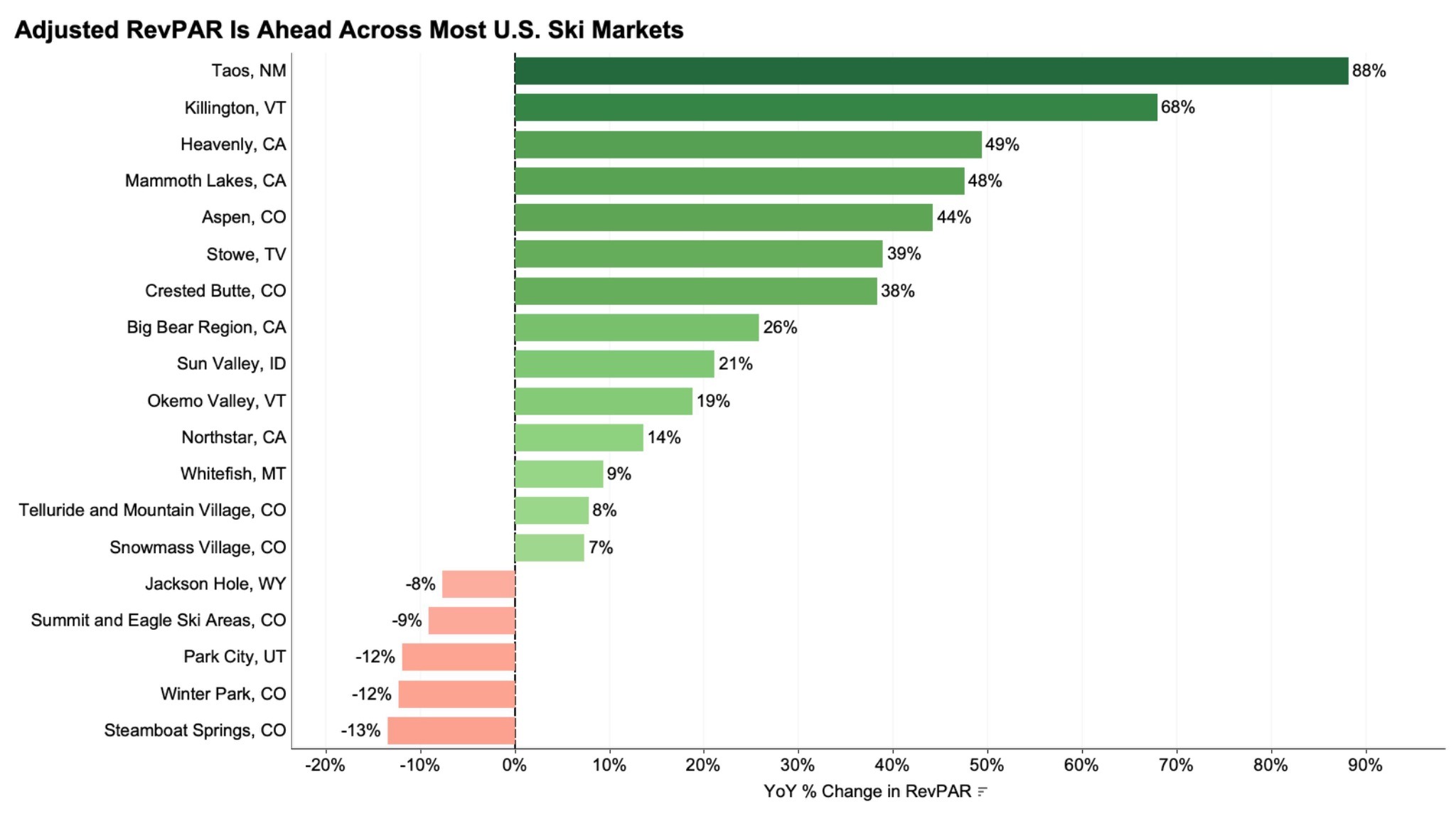
With the 2026–27 ski season (November - April) approaching, early short-term rental pacing is positive across most of the U.S. ski destinations analyzed by KeyData.
Adjusted revenue per available rental (RevPAR) is ahead of last year in 14 of 19 markets. Taos, NM, is pacing furthest ahead at +88%, followed by Killington, VT (+68%), Heavenly, CA (+49%), Mammoth Lakes, CA (+48%), and Aspen, CO (+44%).
The broader pattern of growth is largely occupancy-driven. Taos, NM, has adjusted paid occupancy pacing 87% ahead of last year, increasing from 4.2% to 7.8%, while ADR is nearly flat. Killington, VT, is pacing 63% ahead in adjusted occupancy, at 10.3% compared with 6.3% last year, alongside a 3% increase in ADR. Aspen, CO, is similar, with adjusted occupancy up 44%, from 5.4% to 7.8%, while ADR is essentially unchanged.
Keep in mind, however, that these large percentage gains are coming from a relatively low occupancy base at this stage of the booking cycle. In Taos, NM, for example, an 87% year-over-year increase still means only 7.8% of paid nights are currently occupied. Pacing shows how a market compares with the same point last year, but the absolute adjusted occupancy rate provides important context for how much of the season is actually on the books.
The distinction of low booking percentages but high levels of growth is particularly important this far ahead of winter. A market can post a large percentage increase from a low starting point while still having less occupancy on the books than another destination that is pacing behind.
Stronger Occupancy Is Offsetting Lower Rates in Several Markets
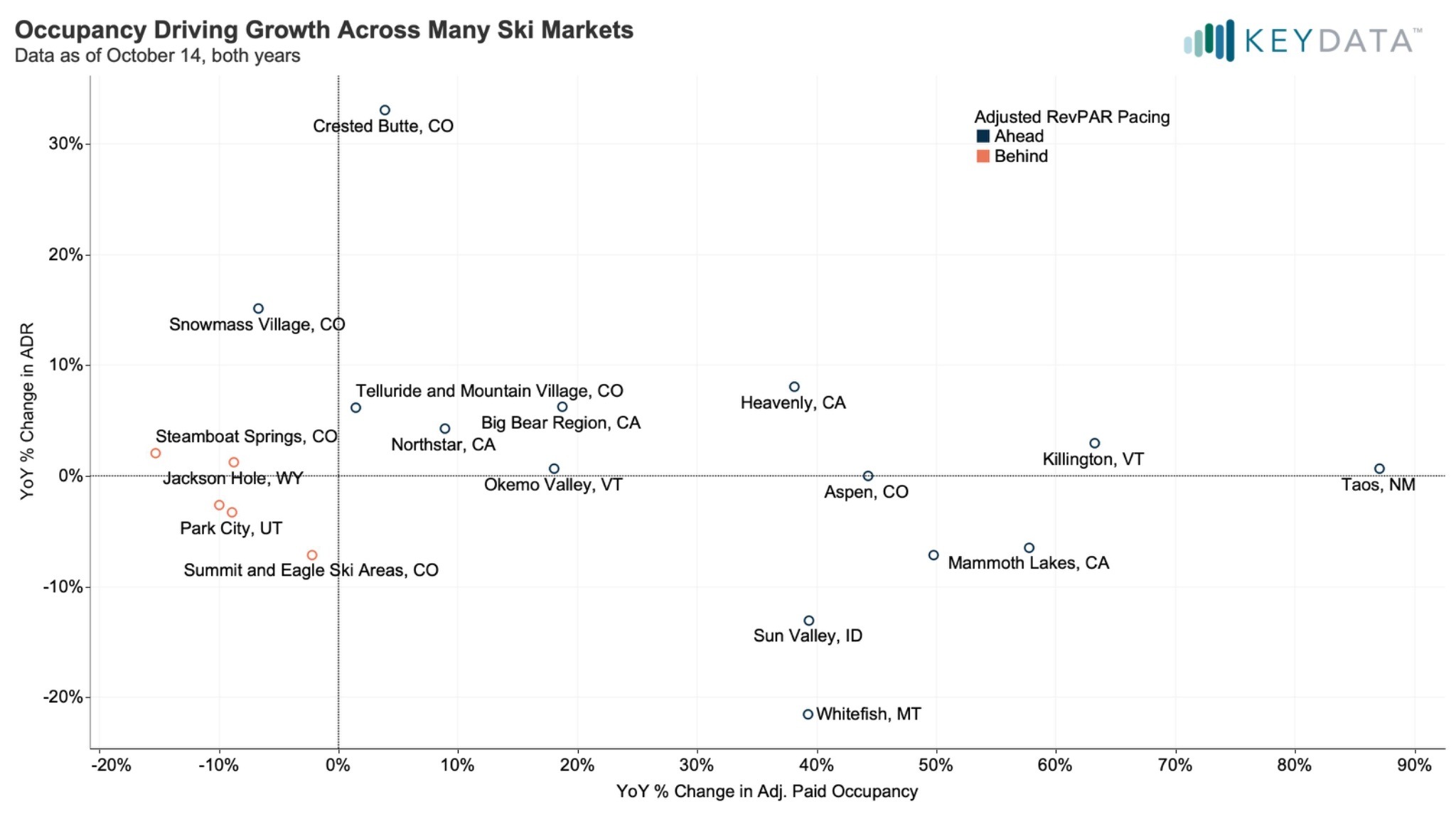
Higher rates are not necessarily driving the destinations pacing furthest ahead. In several markets, occupancy growth is more than compensating for lower ADR. Mammoth Lakes, CA, has adjusted occupancy pacing 58% ahead, increasing from 4.7% to 7.4%, despite ADR being down 6.5%. Stowe, VT, has occupancy up nearly 50%, from 5.9% to 8.8%, while ADR is down 7%. Sun Valley, ID, is pacing 39% ahead in occupancy, increasing from 6.0% to 8.4%, alongside a 13% decline in ADR. Whitefish, MT, shows the same pattern. Adjusted occupancy is pacing 39% ahead while ADR is down 21.5%, yet adjusted RevPAR remains 9% ahead of last year.
Lower ADR in these markets should not automatically be interpreted as evidence of active discounting. Market-level ADR can also change because of differences in the properties, stay dates, and remaining inventory represented in the current booking mix. What the pacing data does show is that stronger occupancy is currently more than offsetting lower average rates in these destinations.
Snowmass Village, CO, provides the clearest example of the opposite pattern. Adjusted occupancy is pacing nearly 7% behind, declining from 20.9% to 19.5%, but ADR is up 15%, keeping adjusted RevPAR 7% ahead.
Across all 19 destinations, there is not a single market where adjusted paid occupancy is pacing ahead while adjusted RevPAR is behind. In markets with strong occupancy growth, higher demand is making up for lower ADR and keeping revenue ahead of last year.
The Markets Pacing Behind Share a Rocky Mountain Pattern
Only five of the 19 markets analyzed have adjusted RevPAR pacing behind last year, and all five are large Rocky Mountain ski destinations. Steamboat Springs, CO, is furthest behind at -13.5%, followed by Winter Park, CO (-12.3%), Park City, UT (-11.9%), Summit and Eagle County Ski Areas, CO (-9.1%), and Jackson Hole, WY (-7.6%).
Occupancy is the main pressure point in four of the five. Adjusted occupancy in Steamboat Springs, CO, is pacing 15% behind, declining from 13.9% to 11.8%. Winter Park, CO, is down 10%, from 13.0% to 11.7%; Park City, UT, is down 9%, from 9.8% to 8.9%; and Jackson Hole, WY, is down 9%, from 13.3% to 12.1%.
Those absolute figures add important context to the YoY comparisons. Steamboat Springs, CO, for example, is pacing 15% behind last year but still has 11.8% adjusted occupancy on the books, compared with 7.8% in Taos, NM, despite Taos, NM, pacing 87% ahead.
Higher rates have not been enough to close the gap in Steamboat Springs, CO, or Jackson Hole, WY, where ADR is up 2% and 1%, respectively. Winter Park, CO, and Park City, UT, are both pacing behind for occupancy and ADR.
Summit and Eagle County Ski Areas, CO, is the exception among the five. Adjusted occupancy is down just 2%, while ADR is 7% lower, making pricing the larger contributor to its 9% adjusted RevPAR decline.
The concentration of slower pacing in the Rockies is worth watching, particularly following a difficult 2025–26 ski season across Colorado and Utah. Record-low snowpack and warmer temperatures affected resort operations, and Colorado Ski Country USA reported skier visits nearly 24% below the previous season. Resorts operated for an average of 129 days, compared with a 20-year average of 144 days.
Last year’s conditions could be one factor affecting how travelers approach this season, particularly among guests willing to wait for more certainty around snowfall. The pacing data cannot establish that relationship, however, and weaker October pacing does not mean these destinations will finish the season behind.
Colorado Shows Why Ski Demand Is Local
Even within Colorado, the current picture is mixed. While Steamboat Springs, CO, Winter Park, CO, and Summit and Eagle County Ski Areas, CO, are pacing behind in adjusted RevPAR, Aspen, CO (+44%), Crested Butte, CO (+38%), Telluride, CO (+8%), and Snowmass Village, CO (+7%) are ahead.
The drivers also vary considerably. Aspen, CO, is almost entirely occupancy-driven, with adjusted occupancy increasing from 5.4% to 7.8%, a 44% gain, while ADR remains essentially flat. Crested Butte, CO, has adjusted occupancy pacing just 4% ahead, but ADR is up 33%. Snowmass Village, CO, is relying on higher ADR to offset adjusted occupancy that is currently below last year’s level.
The split makes it difficult to characterize Colorado as a single ski market. Destinations within the state are entering winter with very different occupancy, pricing, and revenue positions, making market-level pacing more useful than a broad statewide trend.
The comparison period matters here as well. Crested Butte, CO, was among the markets entering last winter from a weaker position, so some of this year’s increase represents a rebound from a softer 2025–26 baseline.
Weather Could Reshape the Picture as Winter Approaches
Weather will become increasingly important as the season develops, particularly following last winter’s challenging conditions across parts of the West.
NOAA expects a strong-to-very strong El Niño to persist through winter. El Niño can shift precipitation and temperature patterns across North America, although its effects vary considerably by region and individual storm.
The seasonal outlook favors wetter conditions across portions of California and the Southwest, which is notable given the strong early pacing in several destinations across those regions.
For higher-elevation destinations, a wetter pattern could support snowpack if temperatures cooperate. Seasonal precipitation forecasts are not snowfall forecasts, however, and individual storm tracks, elevation, and temperature will ultimately determine ski conditions.
The outlook is more mixed farther north, where portions of the northern United States face increased chances of above-normal temperatures and some areas could experience drier conditions.
Despite that uncertainty, northern ski markets are generally entering winter from a stronger pacing position. Sun Valley, ID, and Whitefish, MT, are both ahead in adjusted RevPAR, as are the Vermont destinations included in the analysis: Killington, VT; Stowe, VT; and Okemo Valley, VT.
Current pacing reflects demand secured before actual winter conditions are known. As snowfall begins and resort conditions become clearer, weather could play a larger role in booking pickup, particularly among travelers who have not yet committed to a ski trip.
What to Watch as Ski Season Begins
The current snapshot gives most ski destinations a positive starting point, but a significant portion of the season remains unbooked.
For markets already pacing well ahead, the relationship between occupancy and pricing will be important to watch. Mammoth Lakes, CA; Stowe, VT; Sun Valley, ID; and Whitefish, MT, all have stronger adjusted occupancy but lower ADR than at this point last year. As more demand materializes, property managers will need to determine whether remaining availability can support firmer pricing without slowing booking pace.
For the Rocky Mountain destinations currently behind, booking pickup will be the more important signal. These markets have less adjusted occupancy on the books than they did at the same point last year, but several still have higher absolute occupancy than destinations posting much larger YoY gains. Snowfall, resort openings, pricing changes, and the timing of winter demand could all narrow the current gaps.
Booking windows provide some additional context, but not enough to conclude that guest behavior has changed. Several of the markets with the largest occupancy gains currently have shorter average booking windows among reservations on the books than markets pacing behind. That tells us stronger pacing is not simply the result of having demand secured further in advance. Without comparing booking windows at equivalent points across seasons, however, it does not tell us whether guests are actually booking earlier or later this year.
A Positive Start, With Plenty of Winter Left to Book
Heading into the 2026–27 ski season, the broad picture is positive. Adjusted RevPAR is pacing ahead in 14 of the 19 markets analyzed, with occupancy driving much of the improvement.
But the size of the YoY gains does not tell the whole story. Some of the destinations pacing furthest ahead are growing from relatively low occupancy levels, while several markets pacing behind still have more of their adjusted available nights occupied.
That distinction is particularly important at this stage of the booking cycle. Pacing shows whether a market is ahead or behind its position last year; absolute occupancy shows where that market actually stands today.
The regional differences are also clear. The five markets pacing behind are concentrated in the Rocky Mountains, while destinations across Vermont, California, New Mexico, Idaho, and Montana are entering winter ahead. Within Colorado itself, performance ranges from double-digit declines to some of the strongest gains in the analysis.
Weather adds another variable. After a difficult 2025–26 season across parts of the West, El Niño could bring a different precipitation pattern this winter. How that translates into snowfall, resort conditions, and booking pickup will become clearer as the season approaches.
For now, the data points to a positive but still developing ski season. The next several weeks should provide a clearer picture of whether today’s strongest gains hold, whether the Rocky Mountain markets begin to close the gap, and how much pricing power emerges as more of the winter calendar fills. Have questions about your market? Reach out to our team for a free custom market report so you can see your individual performance!
Frequently Asked Questions
How are ski season vacation rentals pacing for 2026–27?
Adjusted RevPAR is pacing ahead of last year in 14 of 19 U.S. ski markets analyzed by KeyData. Much of the growth is being driven by stronger adjusted paid occupancy, although several of the largest percentage increases are coming from relatively low occupancy levels.
Which ski destinations are pacing furthest ahead?
Taos, NM (+88%), Killington, VT (+68%), Heavenly, CA (+49%), Mammoth Lakes, CA (+48%), and Aspen, CO (+44%) have the largest YoY increases in adjusted RevPAR.
Why are some of the YoY occupancy increases so large?
Some markets are growing from relatively low starting points. In Taos, NM, for example, adjusted occupancy is pacing 87% ahead, but that represents an increase from 4.2% to 7.8%. Looking at both the YoY change and absolute adjusted occupancy provides a more complete picture of current pacing.
Which ski markets are pacing behind last year?
Steamboat Springs, CO; Winter Park, CO; Park City, UT; Summit and Eagle County Ski Areas, CO; and Jackson Hole, WY, are currently pacing behind in adjusted RevPAR.
How could El Niño affect the 2026–27 ski season?
El Niño is expected to influence winter weather patterns across the United States, with wetter conditions favored across portions of California and the Southwest. Seasonal outlooks indicate probabilities rather than specific snowfall totals, so local temperatures and individual storm patterns will ultimately determine ski conditions.





