


Key takeaways
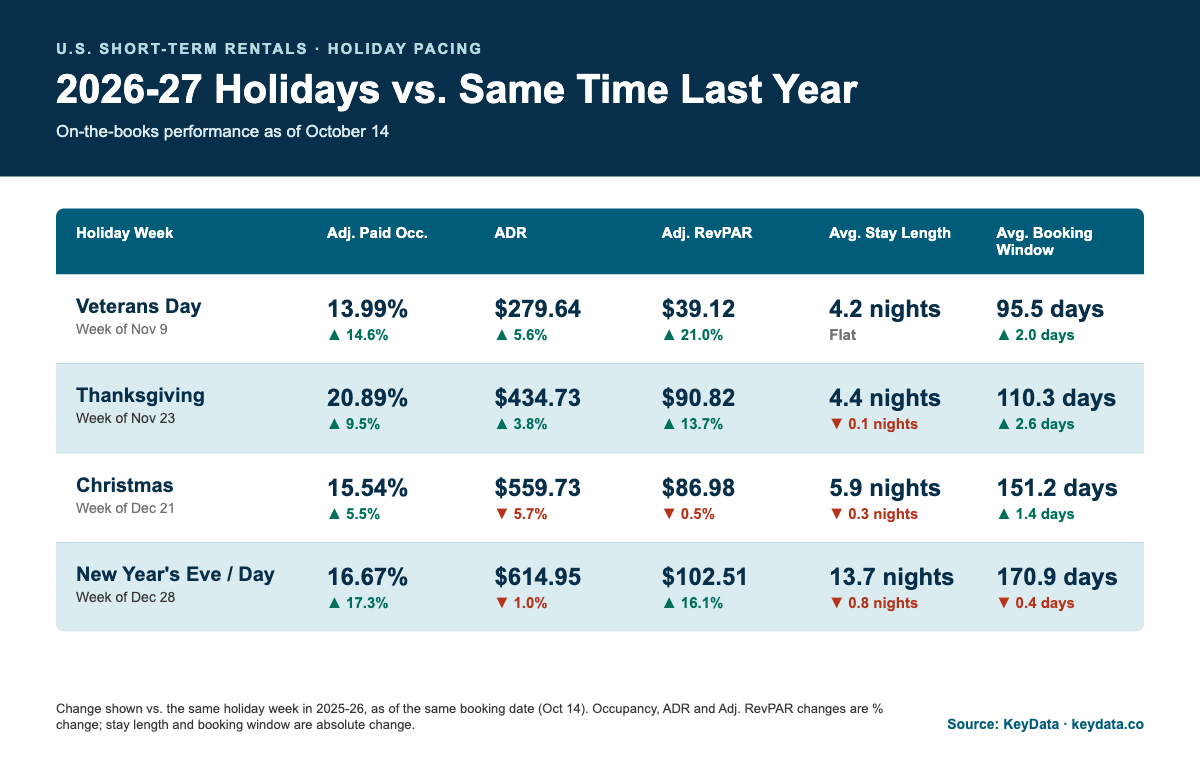
- Holiday occupancy is pacing ahead across the board. Adjusted paid occupancy is up year over year for Veterans Day, Thanksgiving, Christmas and New Year’s.
- Veterans Day leads revenue growth. Adjusted RevPAR is pacing 21.0% higher, supported by gains in both occupancy (+14.6%) and ADR (+5.6%).
- Thanksgiving is also seeing broad-based growth. Occupancy is up 9.5%, ADR is up 3.8% and adjusted RevPAR is up 13.7%.
- Christmas is the outlier on rates. Occupancy is pacing 5.5% ahead, but ADR is down 5.7%, leaving adjusted RevPAR nearly flat.
- New Year’s has the largest occupancy gain. Adjusted paid occupancy is up 17.3%, helping drive a 16.1% increase in adjusted RevPAR despite slightly lower rates.
Holiday demand is building across the U.S. short-term rental market, with adjusted paid occupancy pacing ahead of last year for Veterans Day, Thanksgiving, Christmas and New Year’s. But the source of that growth changes as the calendar moves toward the end of the year.
November holidays are seeing gains in both occupancy and rates
Veterans Day week is currently showing the strongest revenue growth of the four holiday periods. Adjusted paid occupancy is pacing 14.6% ahead of last year at 14.0%, while ADR is up 5.6% to $280. Together, those gains have pushed adjusted RevPAR 21.0% higher.
Rates are also notably strong compared with recent years. At the same point in the booking cycle, Veterans Day ADR has moved from $264 to $255 to $265 and now $280 over the past four years, making 2026 the highest of the period.
Thanksgiving is following a similar, though more moderate, pattern. Adjusted paid occupancy is currently 20.9%, up 9.5% year over year, while ADR has increased 3.8% to $435. Adjusted RevPAR is consequently pacing 13.7% ahead of last year.
Thanksgiving rates have now increased for two consecutive years, rising from approximately $400 in 2024 to $435 this year. Average stay length has remained relatively steady at 4.4 nights, while the average booking window has increased slightly to 110 days.
Christmas demand is stronger, but rates continue to soften
Christmas demand looks different. Adjusted paid occupancy is pacing 5.5% ahead of last year at 15.5%, but ADR is down 5.7% to $560. Those trends largely offset one another, leaving adjusted RevPAR nearly flat at −0.5%. The decline in rates is part of a longer trend. Christmas ADR at this point in the booking cycle has fallen from $647 to $608 to $594 and now $560 over the past four years.
Guests are also booking shorter Christmas stays. Average stay length has declined from 8.0 nights three years ago to 5.9 nights this year. That combination of higher occupancy, lower rates and shorter stays suggests operators are filling more available nights heading into Christmas, but at lower nightly rates than in recent years.
New Year’s is seeing the largest occupancy gain
New Year’s week currently has the strongest occupancy growth of the four holidays. Adjusted paid occupancy is 16.7%, up 17.3% from last year. With ADR nearly flat at $615, down just 1.0%, adjusted RevPAR is pacing 16.1% higher.
The calendar may be helping. New Year’s Eve falls on a Thursday this year, with New Year’s Day on Friday, creating a natural three-day weekend for many travelers. New Year’s stays also remain considerably longer than the other holiday periods, averaging 13.7 nights. However, that figure has been trending downward and is now four nights shorter than the 17.7-night average recorded two years ago.
Demand is ahead, but the pricing story is mixed
Across all four holiday periods, the common thread is stronger occupancy. Adjusted paid occupancy is pacing between 5.5% and 17.3% ahead of last year, with the largest gains around New Year’s and Veterans Day.
Pricing tells a more divided story. Veterans Day and Thanksgiving are pairing higher demand with higher ADR, producing double-digit RevPAR gains. Christmas and New Year’s are attracting more booked nights without the same rate growth.
With several weeks of booking activity still ahead, especially for the December holidays, the final results may shift. For now, the data points to healthy holiday demand heading into the end of 2026, with November showing stronger pricing power and December relying more heavily on occupancy growth.
Frequently asked questions
How are U.S. vacation rentals pacing for the 2026 holiday season?
Adjusted paid occupancy is pacing ahead of last year across all four holiday periods analyzed. Year-over-year gains range from 5.5% for Christmas week to 17.3% for New Year’s week.
Which 2026 holiday is seeing the strongest vacation rental revenue growth?
Veterans Day currently leads, with adjusted RevPAR pacing 21.0% ahead of last year. New Year’s follows at +16.1%, while Thanksgiving is up 13.7%.
Are vacation rental rates increasing for the holidays?
It depends on the holiday. ADR is pacing 5.6% higher for Veterans Day and 3.8% higher for Thanksgiving. Christmas ADR is down 5.7%, while New Year’s is nearly flat at −1.0%.
What is happening with Christmas vacation rental demand?
Christmas occupancy is pacing 5.5% ahead of last year, but ADR is 5.7% lower. As a result, adjusted RevPAR is nearly flat at −0.5%. Average stay length has also declined to 5.9 nights.





